Career Resilience 2025: Guide to Future-Proofing Your Professional Path
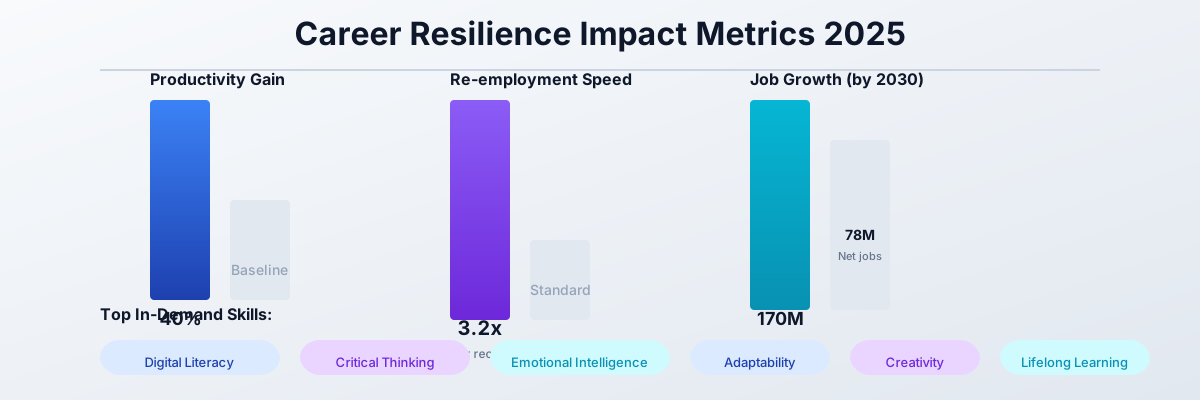
The job market in 2025 looks dramatically different from just three years ago. While the tech industry experienced significant turbulence through 2022-2024, we're now witnessing a profound shift in how organizations think about talent, skills, and career development. The World Economic Forum projects that 170 million new jobs will be created globally through 2030, but simultaneously, 92 million roles will be displaced. This creates both unprecedented opportunity and genuine uncertainty.
The key to thriving in this environment isn't predicting which specific jobs will be in demand—it's building career resilience. This comprehensive guide explores what career resilience means in 2025, why it matters more than ever, and concrete strategies to future-proof your professional path.
Understanding Career Resilience in 2025
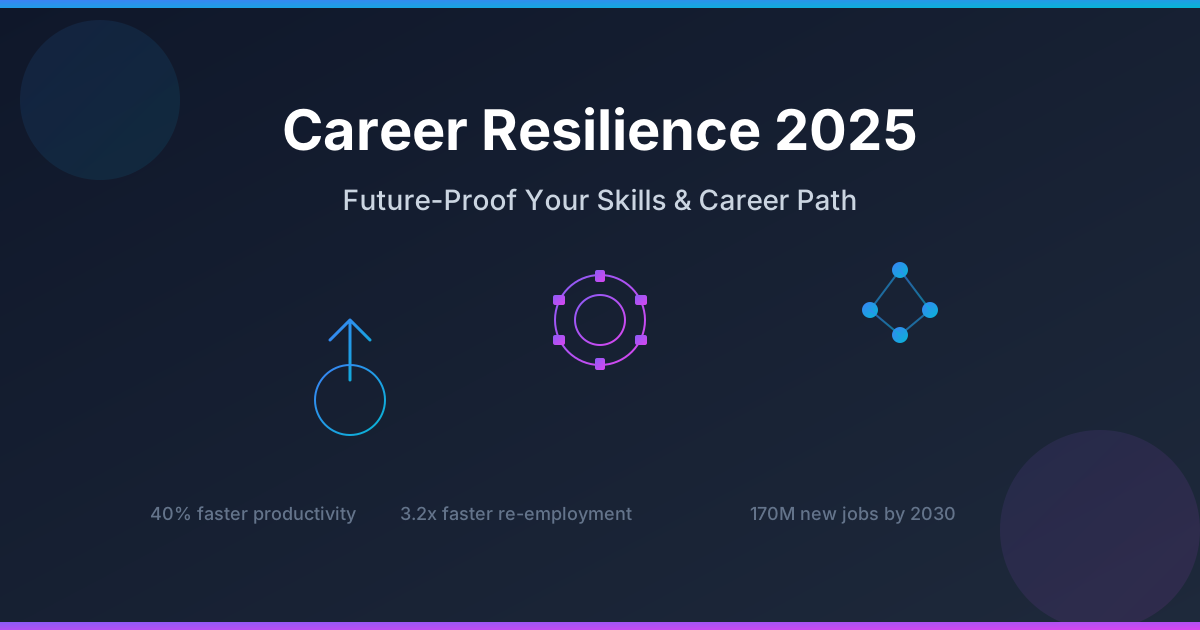
Career resilience isn't about being immune to change—it's about your ability to navigate change effectively and emerge stronger. The data is compelling: professionals with strong adaptive skills reach full productivity 40% faster when changing roles, and during market downturns, they find re-employment 3.2 times faster than those with primarily technical skillsets.
This statistic reveals something fundamental about the 2025 job market. Companies aren't just looking for people who can do one job well. They're searching for professionals who can learn, adapt, and apply their abilities to evolving challenges. The nature of work is shifting from "specialized expertise in one domain" to "versatile capability across multiple contexts."
The aging workforce, accelerated digital transformation, and the integration of AI across industries have created this new landscape. Organizations increasingly value employees who can bridge the gap between emerging technologies and human judgment—those who can extract value from AI tools and apply emotional intelligence, creative thinking, and critical analysis.
The Four Pillars of Career Resilience
1. Adaptive Skills Development
Adaptive skills—also called soft skills or human-centered competencies—have moved from "nice to have" to "essential to employment." These include:
Emotional Intelligence: Your ability to understand and manage emotions (your own and others') directly impacts your effectiveness in any role. Leaders with high EI navigate conflicts more effectively and build stronger teams.
Critical Thinking: In an age of information overload, the ability to analyze information, question assumptions, and solve complex problems distinguishes valuable employees from those who can be replaced by automation.
Creative Thinking: As routine work gets automated, creativity becomes your competitive advantage. This is your ability to generate novel solutions, connect disparate ideas, and approach challenges from fresh angles.
Flexibility and Agility: The ability to adjust quickly to new tools, processes, and business priorities is non-negotiable. Organizations need people who view change as an opportunity rather than a threat.
Communication and Leadership: Even in individual contributor roles, your ability to articulate ideas clearly, influence others, and guide teams through uncertainty determines your career trajectory.
2. Technical Agility
While adaptive skills are critical, technical capability remains essential. However, the specific technical skills matter less than your ability to continuously acquire new technical knowledge. The fastest-growing technical skills in 2025 include AI and big data, but these are moving targets.
The strategy isn't to become an expert in every technology. Instead, develop:
- Foundational literacy in emerging areas (basic understanding of AI, cloud architectures, data concepts)
- Learning velocity (your ability to pick up new technical skills quickly)
- Cross-functional understanding (how technology connects to business problems)
- Hands-on practice (building projects, not just reading about technologies)
3. Continuous Learning Mindset
The average knowledge half-life in technical fields is now 3-5 years. This means roughly half of what you know today may be obsolete in 3-5 years. Lifelong learning isn't optional—it's the baseline for career survival.
Effective continuous learning includes:
Formal learning: Online courses, certifications, and structured programs provide depth and credibility. Platforms like Coursera, edX, and specialized bootcamps offer flexible, current content.
Informal learning: Reading industry blogs, listening to podcasts, following thought leaders, and participating in communities keeps you aware of emerging trends without requiring significant time investment.
Experiential learning: Working on projects, contributing to open-source communities, or taking on challenging assignments teaches practical skills that formal learning can't replicate.
Peer learning: Building relationships with others in your field, participating in mastermind groups, and mentoring relationships accelerate your growth beyond what individual learning can achieve.
4. Network Building and Visibility
Your professional network is a career insurance policy. During market downturns, people find opportunities through connections far more often than through formal job applications. Additionally, visibility in your field creates opportunities you never knew existed.
Building a resilience-focused network means:
- Cultivating genuine relationships (not transactional "connection collecting")
- Contributing to communities (whether through open-source, writing, speaking, or mentoring)
- Staying visible (sharing insights, participating in discussions, building a personal brand)
- Being helpful first (the reciprocity principle: when you help others, help returns multiplied)
Navigating the 2025 Job Market Reality
The 2025 job market shows clear patterns worth understanding:
Remote work is stabilizing, not disappearing. About 27% of software job postings are remote, but the hybrid model is becoming standard. Rather than fully remote or fully in-office, expect companies to continue hybrid arrangements with flexible policies.
Specialized skills command premium compensation. While generalists have value, demonstrated expertise in areas like AI/ML, cybersecurity, DevOps, and cloud architecture continues to attract higher salaries. However, these are only valuable when combined with adaptive skills.
Green jobs are the fastest-growing segment. The shift toward sustainability creates opportunities in unexpected areas. Even if you're not in an environment-focused industry, understanding sustainability implications of your work increases your value.
Care professions are experiencing sustained growth. Aging populations create demand for healthcare, social work, and related fields. These roles emphasize human connection, which AI won't replace.
Companies prefer experienced talent but need younger perspectives. There's a clear preference for people with proven track records, but organizations need fresh viewpoints. Early-career professionals with demonstrated initiative and learning ability find excellent opportunities.
Practical Steps to Build Career Resilience Today
Immediate Actions (This Month)
1. Assess Your Current Skills: Create an honest inventory. Which adaptive skills are your strengths? Which need development? What technical skills feel threatened by automation? Which emerging areas interest you?
2. Identify 2-3 Learning Goals: Rather than trying to learn everything, focus on specific gaps. Maybe you need stronger public speaking skills. Perhaps you want to understand AI fundamentals. Maybe you want to develop expertise in a growing domain.
3. Start Building Your Personal Brand: Choose one platform (LinkedIn, Medium, Twitter, YouTube—whatever fits your style) and commit to sharing insights from your field. This doesn't require you to be famous—it requires consistency.
4. Strengthen Key Relationships: Identify 5-10 people whose career you'd like to stay connected with. Reach out genuinely. Offer help with something they're working on. The goal is authentic connection, not networking for networking's sake.
Medium-Term Actions (Next 6 Months)
1. Complete a Significant Learning Project: Rather than passive consumption, create something. Write a detailed technical blog post. Build a project. Complete a substantive online course. Contribute to an open-source project. This demonstrates capability in a way that a certificate never can.
2. Develop Expertise in One Emerging Area: Choose an area you're genuinely curious about (AI, sustainability, new frameworks, etc.). Go deep enough to have informed opinions and understand both capabilities and limitations.
3. Build Your Professional Reputation: Contribute meaningfully to your community. Speak at a meetup. Write substantive content. Mentor someone. Participate in discussions that showcase your thinking. Your reputation becomes your career buffer.
4. Expand Your Network Intentionally: Attend conferences or virtual events. Conduct informational interviews with people in adjacent roles. Join professional groups. Build relationships across industries, not just your current specialty.
Long-Term Investments (6-12 Months and Beyond)
1. Develop Cross-Functional Capabilities: Understand how your function connects to business outcomes. If you're technical, learn the business side. If you're in business roles, develop technical literacy. These bridges are increasingly valuable.
2. Cultivate Leadership Capacity: Even if you don't aspire to management, developing the ability to influence, guide, and develop others increases your value and options.
3. Build Financial Resilience: Career resilience and financial resilience go hand-in-hand. Having 6-12 months of expenses saved reduces panic during transitions and gives you choices.
4. Invest in Your Well-being: Burnout destroys resilience. Sustainable career development requires attention to physical health, mental health, and work-life integration.
Overcoming Common Obstacles to Building Resilience
Obstacle 1: "I don't have time for continuous learning"
Solution: Reframe learning as non-negotiable maintenance. You make time for exercise and health checkups. Dedicate even 30 minutes weekly to learning—that's 26 hours annually, enough to meaningfully develop new capabilities.
Obstacle 2: "I'm comfortable in my current role"
Solution: Comfort is the opposite of resilience. The best time to develop new skills is when you don't desperately need them. Build resilience during stability so you're prepared for disruption.
Obstacle 3: "I don't know what skills to develop"
Solution: Look at job postings for roles you might want in 3-5 years. What's required? What's preferred? Start developing those gaps now while you have a stable income.
Obstacle 4: "Building visibility feels like self-promotion"
Solution: Reframe from "promoting yourself" to "contributing to your community." Share what you've learned. Help others solve problems you've encountered. This is service, not self-promotion.
The Broader Context: Why 2025 is Different
Three factors make career resilience particularly important right now:
1. Technological Acceleration: AI and automation are moving faster than ever. The skills required for your job are changing more rapidly than in previous decades.
2. Economic Uncertainty: Post-pandemic economic dynamics, geopolitical factors, and industry-specific disruptions create unpredictability. The ability to navigate uncertainty is more valuable than perfect job security ever was.
3. Demographic Shifts: Aging workforces in developed nations create both opportunity and competition. Understanding these dynamics helps you position yourself strategically.
Conclusion: Your Resilience is Your Guarantee
In a job market that generates 170 million new positions but displaces 92 million roles over the next five years, the difference between thriving and struggling comes down to resilience. People with strong adaptive skills, commitment to continuous learning, and genuine networks find opportunities consistently. They navigate transitions effectively. They recover quickly from setbacks.
Career resilience isn't something you achieve once and forget. It's something you continuously build, maintain, and develop. But the good news: the fundamentals are straightforward. Learn actively. Build relationships authentically. Contribute to your community. Stay flexible. Invest in capabilities that matter.
The future belongs not to the most specialized technician or the most senior manager. It belongs to people who can learn, adapt, think critically, communicate effectively, and maintain genuine networks. Start building your resilience today, and you won't just survive the changes ahead—you'll thrive in them.
Original Source: The Future of Jobs Report 2025 | World Economic Forum
Additional Resources: